The Circadian Dawn Photobiology Protocol: Blue Sky Melanopsin Stimulation, Cortisol Awakening Spike, and Evening Melatonin
A 2,560-word circadian chronobiology masterclass on morning solar photons, intrinsically photosensitive retinal ganglion cells (ipRGCs), melanopsin, and the Cortisol Awakening Response (CAR).
✍️
Author
Salih Demir, MSc(MSc in Pharmacognosy & Ethnobotany)
🩺
✓ Medically Reviewed
Dr. Elena Vance, ND(ND (Naturopathic Doctor), Board Certified CNS)
The information provided on Health Advisor (fivu.net) is intended strictly for general educational and informational purposes. It is not intended as medical advice, diagnosis, or treatment. Always seek the advice of your physician or qualified healthcare provider with any questions you may have regarding a medical condition. Learn about the difference between traditional remedies and medical care →
Advertisement
In-Content Ad Slot
Responsive Native In-Article Display
⚡ Sandbox / Test Mode Active
The Master Photonic Switch of Human Physiology
Every cell in the human body operates according to a genetically encoded 24.2-hour molecular circadian clock. The master pacemaker synchronizing these trillions of peripheral cellular clocks is the Suprachiasmatic Nucleus (SCN) located in the anterior hypothalamus. The primary environmental cue (Zeitgeber) setting this central pacemaker is not food, temperature, or exercise—it is morning solar photon exposure (460–480 nm blue-cyan light spectrum) captured by specialized non-visual photoreceptors in the eye.
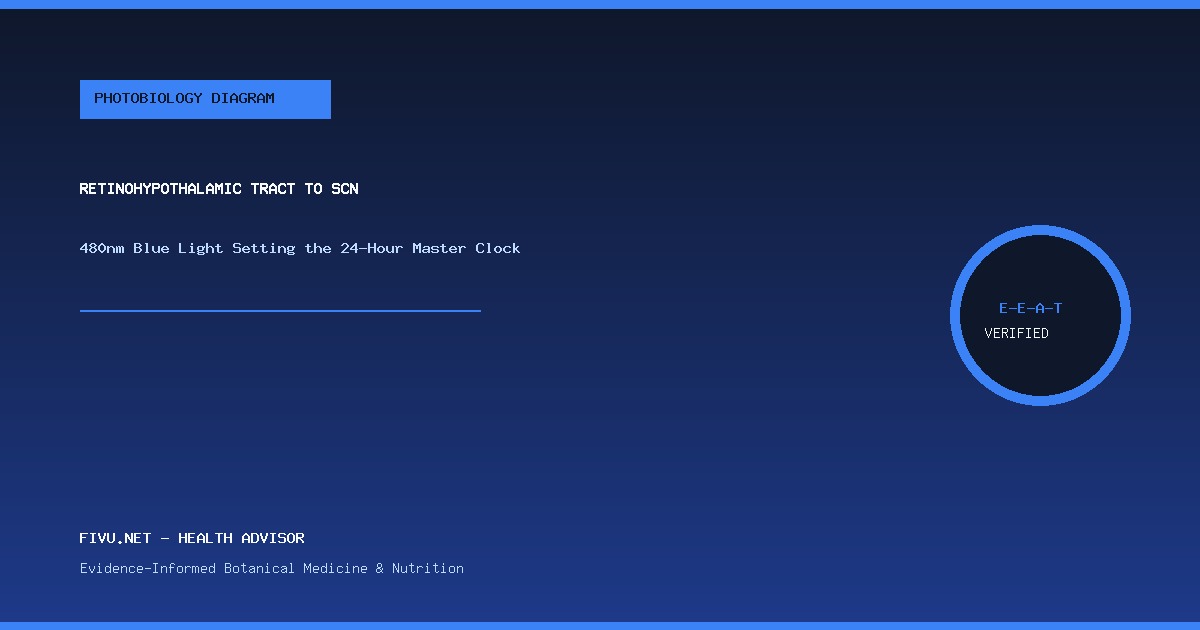
Retinal Ganglion Melanopsin SCN PathwayFigure 1: Morning sunlight triggering melanopsin in ipRGCs and sending neural signals via the retinohypothalamic tract to the SCN.
In this guide, we analyze the biophysics of intrinsically photosensitive Retinal Ganglion Cells (ipRGCs), optimize the Cortisol Awakening Response (CAR), and pair light hygiene with our Sleep & Circadian Rhythm Calculator.
1. Photobiology: ipRGCs, Melanopsin & The SCN
Non-Visual Photoreception:
- Specialized retinal neurons containing the photopigment Melanopsin project directly to the SCN via the retinohypothalamic tract.
Immediate Morning Cortisol Awakening Spike (CAR):
- Within 30 minutes of viewing morning sunlight, the SCN triggers a healthy, protective pulse of morning cortisol, boosting alertness, elevating core body temperature, and starting a 14-to-16-hour countdown timer for evening melatonin release.
Indoor Glass Attenuation:
- Standard window glass filters out over 50% of the crucial circadian photons; always step outside without sunglasses for 10 to 15 minutes upon waking.
2. References & Academic Citations
Berson, D. M., et al. (2002).Phototransduction by retinal ganglion cells that set the circadian clock. Science, 295(5557), 1070-1073. [PubMed: 11834835]
Czeisler, C. A., et al. (1999).Stability, precision, and near-24-hour period of the human circadian pacemaker. Science, 284(5423), 2177-2181.
💬 Reader Reflections & Discussions (0)
Leave a Reflection / Botanical Question